
Transforming Bike Transport for Rail
A Safety-First Collaboration Between Sportworks, Alstom, and Metrolinx
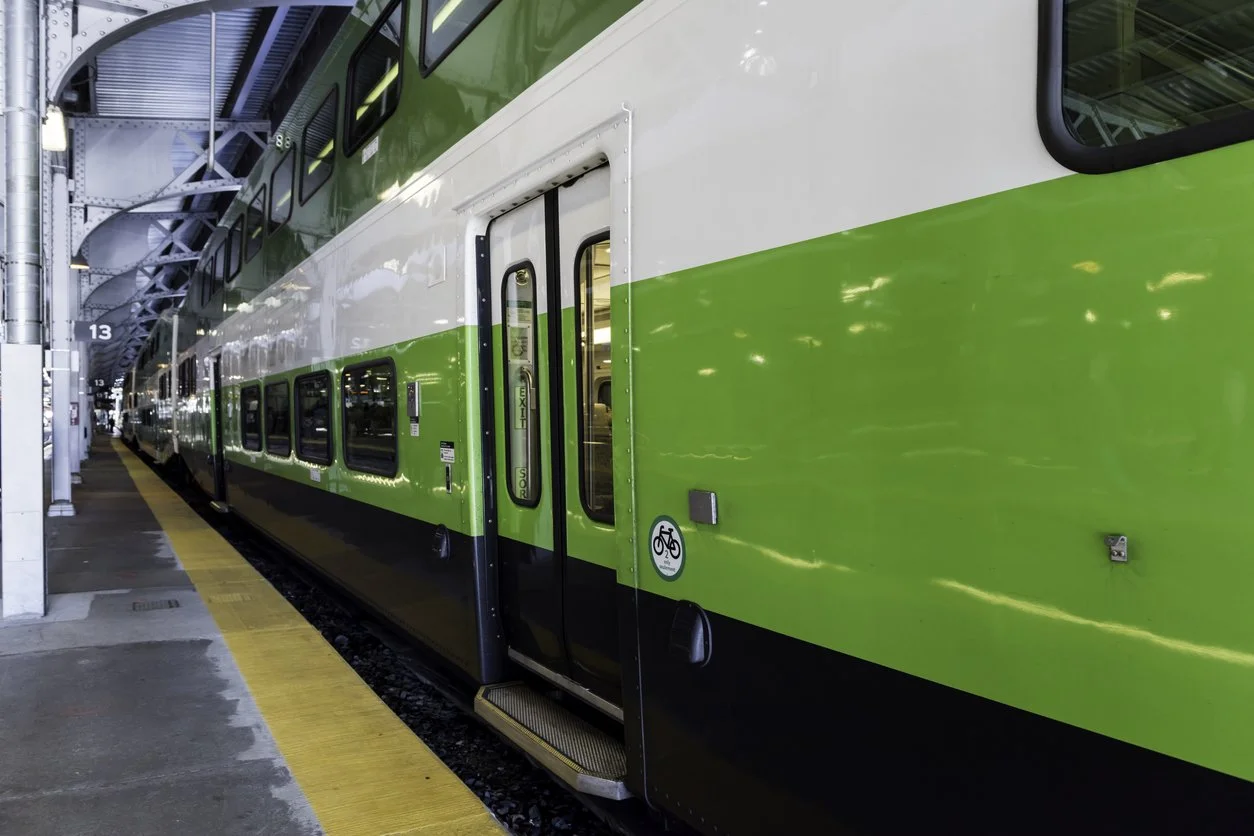
When demand for bicycles onboard GO Transit’s rail network in the Greater Toronto and Hamilton Area began increasing, a response was needed to ensure a safe and convenient commute for riders.
Metrolinx, the provincial transportation agency that oversees GO Transit, is responsible for planning, building, and overseeing the region’s integrated transit network. Its GO Transit rail system plays a pivotal role in connecting riders across Ontario. Known for its forward-thinking approach to mobility, Metrolinx sought a scalable, high-safety solution that would keep pace with evolving rider behavior. As part of their response to the increased demand for bicycles and e-bike transport on their rail network, Metrolinx decided to retrofit eight coaches to more than double their existing bike coach fleet.
To implement such a retrofit, Metrolinx turned to Alstom, the global leader in smart and sustainable mobility solutions. Alstom designs, builds, operates and maintains rail systems around the world, including the GO Transit fleet. With a legacy of innovation and a deep understanding of rolling stock performance and lifecycle management, Alstom recognized that this wasn’t just a customer service problem, it was a systems-level issue that required operational expertise, engineering rigor, and human-centered design.
To meet the challenge, Alstom brought in Sportworks.
A Metrolinx Systems Level Challenge
GO Transit’s railcars weren’t traditionally built to accommodate the scale or complexity of modern bike usage. What began as an occasional rider convenience had evolved into a daily demand, with passengers boarding in growing numbers, many with heavy e-bikes, pannier setups, or oversized cargo attachments. A rising number of riders were also using GO Transit to commute from the suburbs to the city for delivery work, bringing bikes outfitted for courier service, often with bulky gear or cargo boxes that exceeded the limits of available space and further crowding the system.
Without formal accommodations onboard, bikes ended up in aisles, or wedged into vestibules, creating friction between riders and safety concerns that couldn’t be ignored.
Crowded aisles reduced emergency egress. Riders struggled to stabilize their bikes during the journey, especially during acceleration or sudden stops. Boarding and disembarking slowed, causing cascading delays. And in the event of an emergency, the lack of clear pathways posed real risks.
Supporting active transportation is more than simply allowing more bikes onboard, it involves designing a comprehensive solution around them.
The mandate was clear: develop a scalable, durable solution that maintained operational performance, prioritized safety, supported a wide range of bike types, and respected the constraints of existing railcar geometry. Alstom, as the fleet operator and long-time engineering partner, was tasked with leading the retrofit, and they turned to Sportworks to help deliver it.
A Partnership Built Around Problem-Solving
As the manufacturer, operator and maintainer of the GO Transit rail fleet, Alstom led the program management and retrofit effort. They began by conducting a quality audit of Sportworks’ manufacturing processes, ensuring alignment with their own rigorous standards. Once approved, Sportworks worked closely with Alstom’s technical team to develop layout options, validate spacing with bike sizes common on the network, and deliver a solution that would fit onboard GO Transit’s bi-level railcars.
The partnership was grounded in responsiveness and technical rigor. Mounting points, floor space, and weight distribution had to be carefully mapped to existing coach architecture. The solution also needed to withstand the demands of high-frequency commuter service, including vibration, temperature fluctuation, and rider wear-and-tear over time.
Throughout the process, Sportworks provided engineering support, layout guidance, and consultative input to ensure the proven bike transport system would adapt to the GO Transit rail environment.
A Purpose-Built Solution
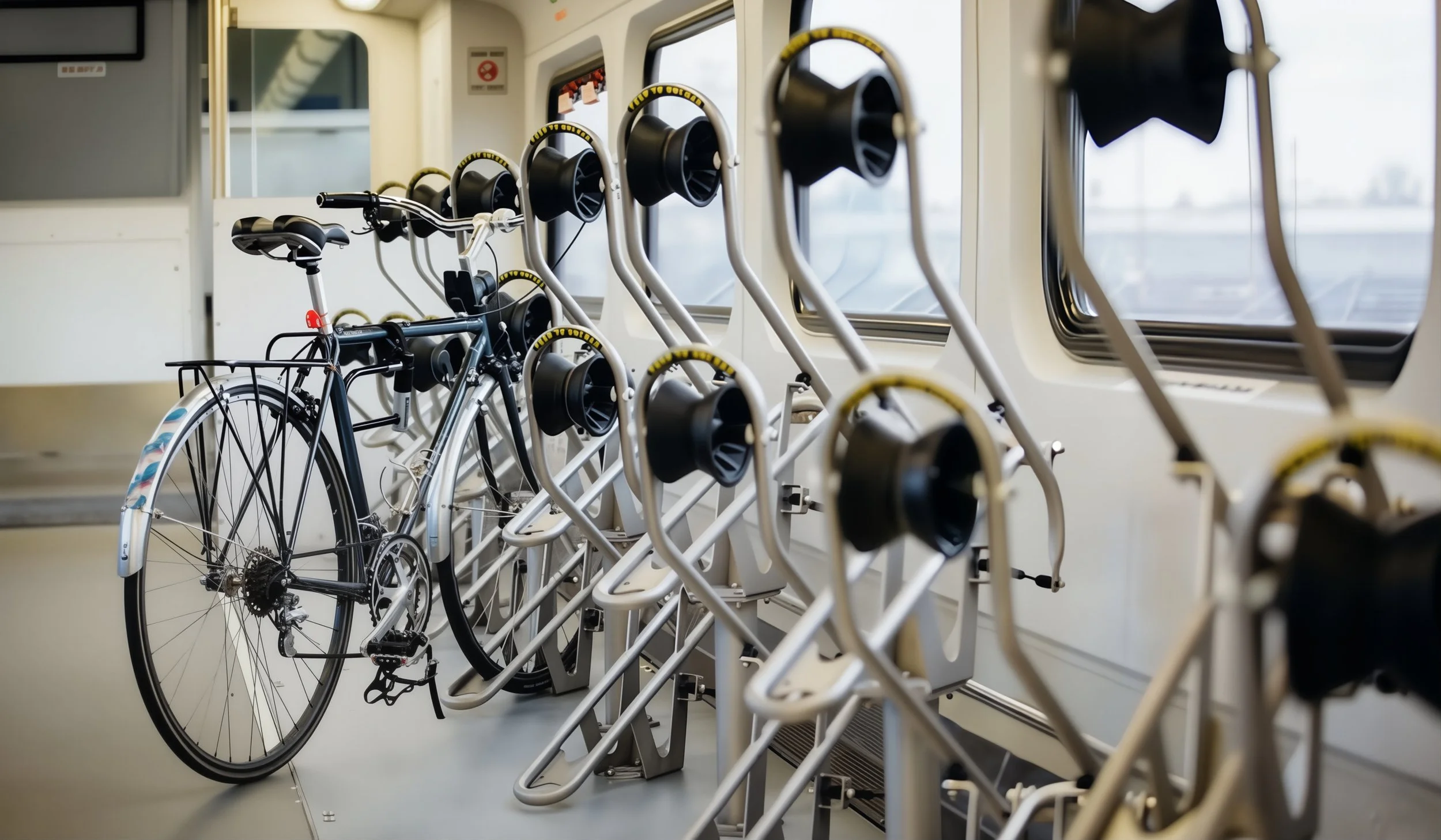
At the core of the retrofit was the Sportworks Spinlock™ vertical bike rack, a system purpose-built for high-capacity transit environments. With a proven track record across North America, Spinlock offered the right combination of secure retention, intuitive usability for riders, and space-efficient design to meet the operational demands of the GO Transit fleet.
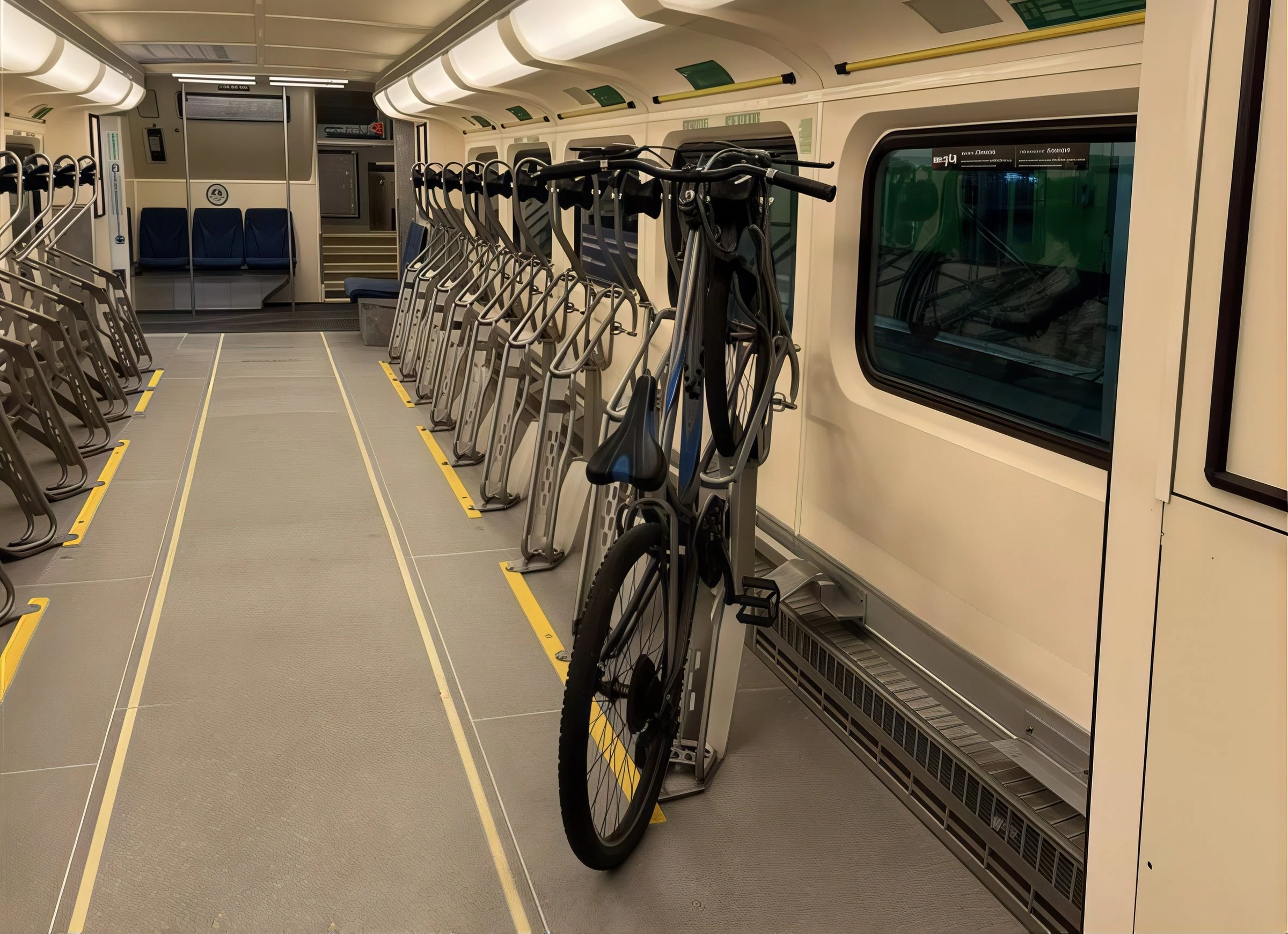
Working in close coordination with Alstom’s engineering team, Sportworks helped configure a layout that would maximize bike capacity while preserving aisle clearance and emergency egress. Eight newly retrofitted coaches joined six legacy cars in the fleet, more than doubling the total number of dedicated cars. The new coaches are designed to accommodate up to 22 bicycles.
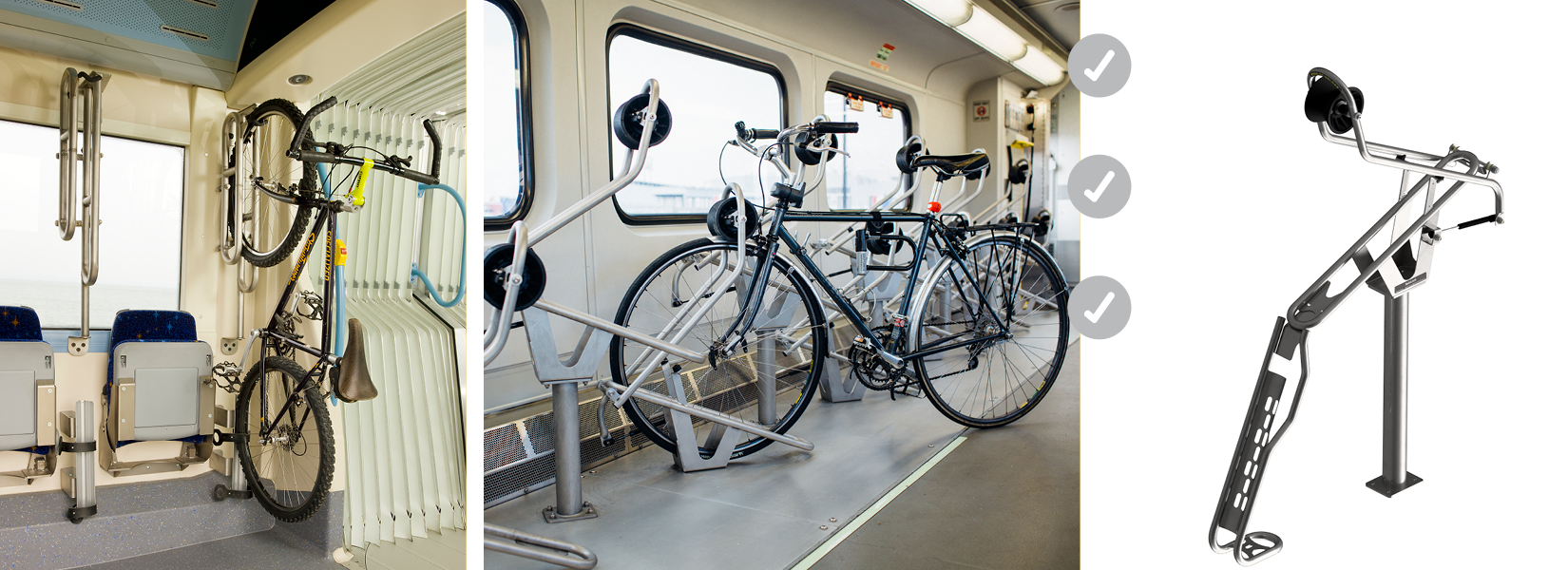
The ramps and risers available with the Spinlock solution allow bikes to be stowed securely and easily while minimizing the amount of floor space used. Riders can simply roll bikes into position, no lifting required, a crucial feature for accommodating e-bikes which are heavier and often harder to maneuver. The system’s one-way ratcheting roller offers exceptional retention, keeping bikes upright and stable during transit, yet allowing for fast loading and unloading.
Importantly, the Spinlock design allows each bike to be loaded and unloaded independently. There’s no stacking, entanglement, or risk of damage, just orderly, efficient boarding and secure transport. Bikes equipped with panniers, delivery boxes, or other attachments fit easily within the system without blocking aisleways or interfering with adjacent bike spaces.
Every detail was engineered for transit reality. Tall pedestals provide vertical support. Durable hardware was built to withstand vibration and high-use cycles. Mounting strategies were adapted to GO Transit’s specific railcar dimensions, ensuring consistent integration across the fleet.
This solution combines operational efficiency, rider usability, and safety, delivered in a format that respects the passenger experience.
From Design to Deployment
Once the Spinlock configuration was finalized, eight GO Transit bike coaches were retrofitted with a consistent layout designed for quick, effortless use. Exterior decals and onboard signage guided cyclists to the correct loading zones, while the vertical orientation and independent loading bays kept aisles clear and emergency egress unobstructed.
The solution wasn’t just functional, it was intuitive.
Proof of Success
The impact of the retrofit was immediate and visible. Before-and-after comparisons revealed a significant improvement in onboard organization, safety, and overall user experience. Bikes that once crowded aisles and vestibules were now secured in a dedicated, orderly system that protected both the bicycles and the surrounding passengers.
Emergency egress paths remained clear and crowding reduced, supporting both safety and operational efficiency.
Internal stakeholders, operators, and maintenance staff reported high satisfaction with the retrofit, noting the durability of the Spinlock system and the ease of daily use. The success of the project has opened the door for broader consideration of bike capacity planning in future rolling stock decisions.
Strategic Impact
This project is a model of how infrastructure partners, transit agencies, and manufacturers can work together to adapt legacy systems to meet modern demands. It highlights how rider needs, safety protocols, and vehicle constraints can all be addressed, not by compromise, but through targeted, collaborative design.
Metrolinx took proactive steps to respond to evolving demand. Alstom delivered engineering excellence and fleet-level integration. Sportworks brought product leadership and technical guidance to ensure that every touchpoint of the solution performed in real-world transit conditions.
Together, the partnership delivers a scalable model for integrating micromobility into passenger rail at a system level. As cities evolve and transportation becomes increasingly multimodal, projects like this set the standard for how to move forward: with collaboration, clarity, and a commitment to safety, rider experience, and maintaining on-time performance.
About Alstom
Alstom commits to contribute to a low carbon future by developing and promoting innovative and sustainable transportation solutions that people enjoy riding. From high-speed trains, metros, monorails, trams, to turnkey systems, services, infrastructure, signaling and digital mobility, Alstom offers its diverse customers the broadest portfolio in the industry. With its presence in 63 countries and a talent base of over 86,000 people from 184 nationalities, the company focuses its design, innovation, and project management skills to where mobility solutions are needed most. Listed in France, Alstom generated sales of €18.5 billion for the fiscal year ending on 31 March 2025.
Discover how Alstom is innovating sustainable mobility solutions.
About Metrolinx
Metrolinx, an agency of the Government of Ontario under the Metrolinx Act, 2006, was created to improve the coordination and integration of all modes of transportation in the Greater Toronto and Hamilton Area.
Metrolinx is undertaking the most extensive transportation investment in Ontario’s history to get you where you need to go better, faster, and easier while also operating GO Transit, UP Express and PRESTO. We have a unique opportunity to plan, build, operate and connect transportation in the Greater Golden Horseshoe.
Explore how Metrolinx transportation is building better travel across Ontario.
About Sportworks
At Sportworks, we’re transforming the way people move by creating transportation solutions that improve the well-being of people and the planet. As champions of active and multimodal transportation, we’re committed to connecting journeys seamlessly with innovative products and technology.
Since launching the first commercial bike rack for buses in 1993, we’ve partnered with transit authorities, municipalities, and infrastructure leaders to make healthier, more sustainable mobility a reality. Trusted worldwide, our solutions connect bus, rail, and cycling networks, helping communities move more efficiently, safely, and sustainably.
Learn how Sportworks is transforming active and multimodal transportation.
Let’s Move Forward Together
Whether you’re adapting legacy fleets, planning new infrastructure, or integrating active transportation into your network, Sportworks can help you design, engineer, and deliver solutions that work in the real world.